Insights
Battery storage can unlock significant value for commercial properties, but the potential varies considerably from one building to another. The single most important factor is how much spare capacity is available in the building's electrical connection.
.jpeg)
Fill out the form and we will be in touch!
Battery storage can unlock significant value for commercial properties, but the potential varies considerably from one building to another. The single most important factor is how much spare capacity is available in the building's electrical connection.
Many commercial properties have more value in their grid connection than their owners realise. With a battery energy storage system, unused capacity can become a new source of revenue while also providing flexibility to the power system.
However, not every building is equally well suited for battery storage. Some have ample spare capacity, the right electrical infrastructure and sufficient space for installation. Others require a more detailed assessment before the business case becomes viable.
At Sunday Power, we look at three key factors when assessing whether a commercial property is suitable for battery storage:
This may sound technical, but in practice it comes down to a simple question:
How much capacity does the building have to allow the battery to charge and discharge without affecting its day-to-day operations?
Much of the value of a commercial battery comes from participating in flexibility and ancillary service markets. In these markets, the battery makes capacity available to support the power system whenever it is needed.
To do this, the battery must be able to charge and discharge quickly. That requires sufficient capacity in the building's grid connection—not just a large main fuse on paper, but genuine spare capacity after the building's own electricity demand has been taken into account.
A building with a large main fuse can therefore be highly attractive. However, if the building already uses most of its available capacity during peak demand, there is little left for the battery. Conversely, a building with lower and more stable electricity consumption may offer greater potential than first expected.
"We often find that property owners are surprised by how much potential already exists in the infrastructure they have in place. Our job is to determine whether that capacity can be utilised safely and profitably," says Jørgen Sørgård Erdal, Head of Energy Storage at Sunday Power.
As a rule of thumb, Sunday Power typically looks for buildings with a main fuse rated at 1,250 A or higher. This often provides sufficient capacity for battery systems to participate in relevant markets. However, the size of the main fuse alone is not decisive. What matters is the spare capacity available.
A building with a 1,600 A main fuse may still have limited capacity available for a battery if most of that capacity is already used during peak demand. Another building with lower electricity consumption may be a stronger candidate, even if it appears less obvious at first glance.
Most commercial battery energy storage systems are designed to operate on a 400 V grid connection. As a result, buildings with a 400 V supply are generally simpler and more cost-effective to work with.
Solutions are also available for buildings with a 230 V grid connection, but these often require additional equipment, such as a transformer. While this is technically feasible, it increases the investment cost and can affect the overall business case.
For many modern commercial buildings, a 400 V connection is already in place. Older buildings and smaller properties may require further assessment.
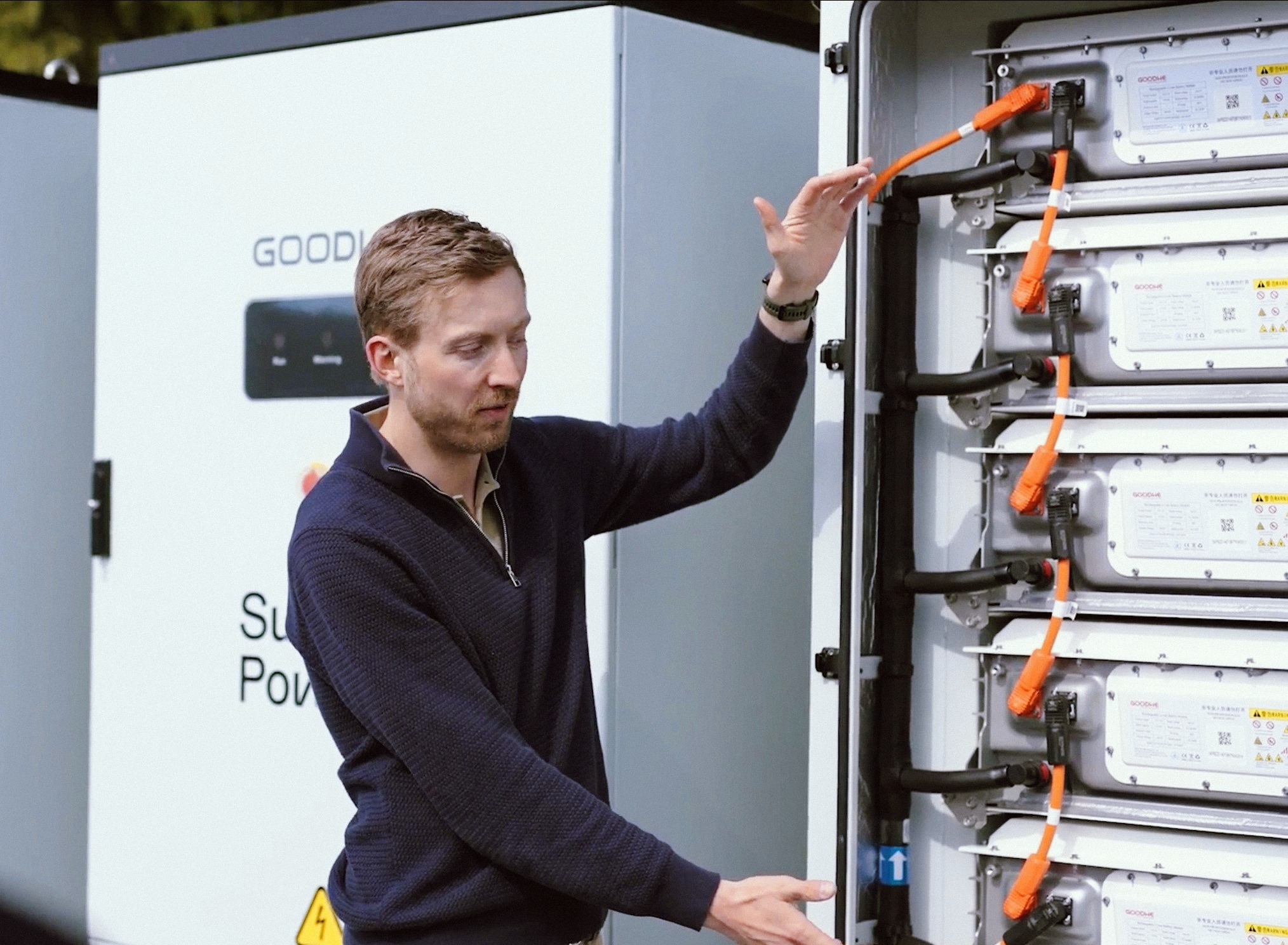
A commercial-scale battery energy storage system requires space. A typical Sunday Power installation occupies approximately 20 to 40 square metres, depending on the system size—roughly equivalent to two to four parking spaces.
The battery can be installed outdoors, in a plant room or within a parking facility, provided the location is suitable. Structural capacity, ceiling height, site access, fire safety requirements and the distance to surrounding buildings all play a role. As a general rule, we aim to install battery systems outdoors and at least eight metres from neighbouring buildings, while always working with the property owner and fire safety consultant to find the most suitable solution.
The location also affects project economics. The closer the battery is to the main switchboard, the simpler and more cost-effective the installation becomes. Long cable runs increase installation costs and can result in higher electrical losses. Battery placement is therefore about more than safety—it also has a direct impact on project delivery and long-term value.
"We always carry out a site assessment to identify the solution that provides the best balance between safety and commercial value. Every property is different, and we need to understand the local conditions before recommending the right solution," says Erdal.
Very few buildings meet every criterion perfectly. One property may have excellent grid capacity but limited available space. Another may have ample space but require electrical upgrades. That does not necessarily mean battery storage is not a viable option.
The key is to assess each property on its own merits. Before recommending a solution, Sunday Power evaluates electricity consumption, the main fuse, available capacity, technical infrastructure and the physical conditions on site. Based on this assessment, we can provide a tailored proposal for either Battery as a Service or a turnkey battery project.
The goal is not to find the perfect building. The goal is to determine whether battery storage can create value for the building as it is today.
For many property owners and asset managers, the process begins with a simple question:
Can battery storage create value for my property?
In most cases, the answer lies in the building's consumption data, the capacity available in the main fuse and the practical conditions on site. Sunday Power can carry out a detailed assessment and demonstrate the property's actual potential.
.jpeg)
These three questions provide a good first indication:
You don't need to have all the answers. Sunday Power can assess your property's potential based on consumption data, technical infrastructure and the available space. Get in touch if you would like us to evaluate your property.